

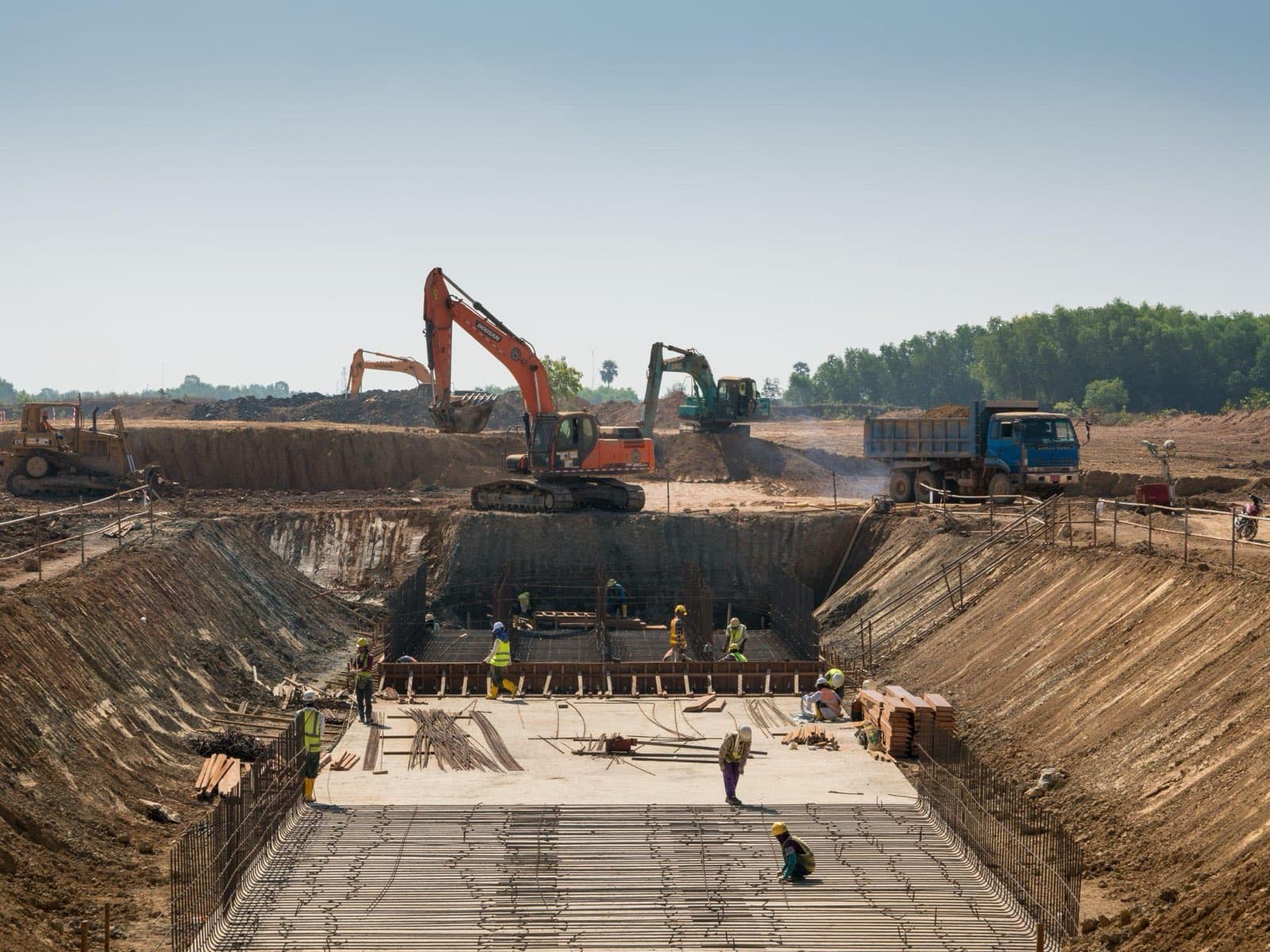
Construction rework is the industry's term for doing finished work over again: tearing out something that was already built and building it back. Sometimes the original work was defective. Just as often it was built exactly as instructed, to a drawing that was outdated, incomplete, or in conflict with a drawing somewhere else in the set.
If you imagine a crew patching a mistake and moving on, you're seeing the cheap part. Industry studies put rework at least 5 percent of contract value on a typical project, and troubled projects push past 20 percent. The fastest way I know to make that concrete is examples: two ordinary ones first, then two that made national news.
The ordinary version
Take a corridor ceiling in a mid-rise office building. The mechanical contractor hangs ductwork exactly where their drawings say it goes. Two weeks later the sprinkler contractor shows up, and their main line belongs in the space the duct now occupies. The steel above can't take new penetrations, so the duct comes down, gets rerouted, and goes back up. Neither crew did anything wrong. The conflict sat in two sets of drawings for months. The first person to see both at once was a foreman standing under a ceiling with no room left in it.
The tear-out itself might be a few thousand dollars. What compounds is everything around it: the sprinkler crew stands down, ceiling grid and drywall slide behind them, the delay reaches every trade sequenced after that corridor, and the whole thing lands on the owner's desk as a five-figure change order. The same conflict caught in design review would have cost a few hours of drafting time.
Or take a concrete deck pour. The electrical contractor needs sleeves cast into the slab for conduit runs. A revision moved those penetrations ten days before the pour, but the crew poured from the older set. Every missed sleeve is now a core drill through cured concrete: scan the slab so you don't cut a tendon, get the structural engineer to sign off on each hole, drill, patch, document. A sleeve set before the pour is a piece of plastic and ten minutes of labor. The same opening made afterward costs multiples of that, times every sleeve that was missed.
Stories like these don't make trade magazines. This kind of rework lands as change orders, month after month, and it's where most of that 5 percent lives.
When rework makes the news
Scale the same mechanics up and you get projects that turned into case studies.
The Harmon Hotel in Las Vegas was designed as a 49-story hotel and condo tower at the CityCenter development on the Strip. In July 2008, with the tower 22 floors up, the project's structural engineer found rebar installed in the wrong locations on 15 of those floors, and most of it was already buried in concrete. The third-party inspection firm, it turned out, had falsified 62 daily reports saying the rebar was fine. MGM capped the building at 28 floors and finished the exterior as a shell while the lawsuits ran. Inspections during the litigation showed the tower was vulnerable to collapse in a strong earthquake, and repairing it was judged not worth the cost. The Harmon came down floor by floor between 2014 and 2015, with roughly $275 million spent on a building that never opened.
The Salesforce Transit Center in San Francisco opened in August 2018, a $2.2 billion transit hub. Six weeks later, workers installing ceiling panels found a cracked steel girder spanning Fremont Street, and a second cracked beam turned up the next day. The whole facility closed. Investigators traced the fractures to flaws introduced during fabrication, at holes cut into the beams for welding. Repairing two beams was the small part. The center stayed closed for more than nine months while the fix went in and the rest of the structure was rechecked, with buses rerouted onto downtown streets the whole time.
Outside the US there's Berlin Brandenburg Airport, which opened nine years late in 2020 after inspectors logged tens of thousands of defects and the fire protection system had to be rebuilt.
Why it keeps happening
Rework is usually a coordination failure, and only sometimes a craftsmanship one. Crews build what the documents in their hands tell them to build. On a large project those documents run into the thousands, revisions land weekly, and decisions travel by email and RFI. When FMI surveyed US builders in 2018, respondents traced 48 percent of rework to poor project data and miscommunication, about $31 billion a year, and reported losing more than 14 hours a week to hunting for project information and dealing with mistakes and rework. That survey is eight years old, and it's still the number the industry quotes.
Look back at the examples and the pattern holds. The Harmon's rebar problem was documented, then papered over, while the concrete went in. The duct and the sprinkler main coexisted on paper for months before they collided above a ceiling. The information existed. It didn't get in front of someone who could act on it while the fix was still cheap.
Where Captus comes in
That gap is the problem we work on at Captus.ai. My team builds AI that reads a project's documents, drawings, and communications and flags conflicts before they reach the field, while the fix is still a revision instead of a change order. We built it for CRE developers and owners who want to finish projects on time and on budget. If you'd like to see what it catches on one of your projects, reach out.